
Cyclast-50 Capsule
Ciclosporin (Cyclosporine) Capsules IP 50 mg
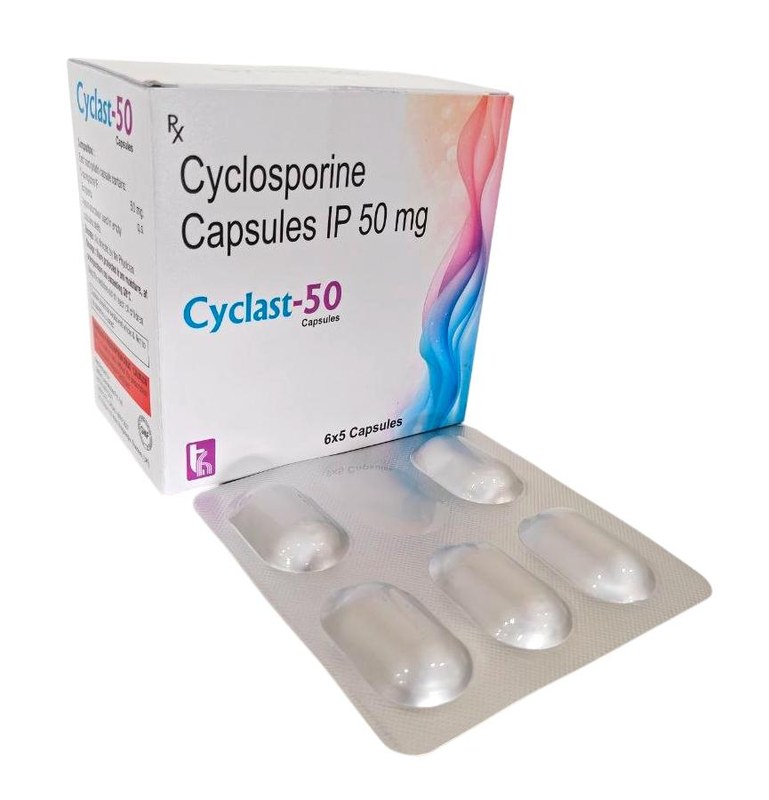
| Composition | Ciclosporin (Cyclosporine) IP 50 mg |
|---|---|
| Dosage Form | Capsule |
| Pack Type | Alu-Alu Blister |
| Pack Size | 6 x 5 Capsules |
| MRP | ₹ 1776 |
| Therapy | Dermatology / Orthopaedics / Nephrology — Calcineurin Inhibitor — Immunosuppressant |
| Storage | Store below 30 °C in a dry place, protected from light and moisture. Do not refrigerate. Keep the capsule in its original blister until use. Keep out of reach of children. |
📱 WhatsApp Enquiry📞 Call: +919041677932
About Cyclast-50 Capsule
Cyclast-50 Capsule contains Ciclosporin (Cyclosporine) IP 50 mg — a calcineurin-inhibitor immunosuppressant indicated for the management of severe, treatment-resistant autoimmune and inflammatory conditions, and for prophylaxis of organ rejection following transplantation. Manufactured by Trumac Healthcare under WHO-GMP certified conditions and supplied in moisture-resistant Alu-Alu blisters that protect the capsule from humidity during Indian climatic transit.
Ciclosporin is a cyclic polypeptide of 11 amino acids that selectively and reversibly inhibits calcineurin, blocking T-lymphocyte activation at the transcriptional level. Unlike broad cytotoxic immunosuppressants, it targets the immune-mediated inflammatory cascade at its source without significant myelosuppression — which is why it remains a mainstay in severe plaque psoriasis, severe atopic dermatitis, refractory urticaria, pyoderma gangrenosum, active rheumatoid arthritis inadequately controlled by DMARDs, steroid-dependent and steroid-resistant nephrotic syndrome, ulcerative colitis and uveitis.
The 50 mg strength allows finer dose titration — essential because ciclosporin is dosed on a mg/kg basis. It is used for lower total daily doses, for stepwise dose escalation and tapering, and in smaller-bodyweight and paediatric patients. It is frequently combined with the 100 mg strength to achieve an exact daily dose. Ciclosporin is a specialist-initiated therapy requiring regular blood pressure and renal function monitoring. Cyclast-50 is available for pan-India monopoly PCD franchise and third-party manufacturing under your own brand.
Indications
- Severe plaque psoriasis unresponsive to conventional systemic therapy
- Severe atopic dermatitis (eczema) refractory to topical and conventional treatment
- Chronic refractory urticaria not controlled by antihistamines
- Pyoderma gangrenosum
- Active rheumatoid arthritis inadequately controlled by conventional DMARDs
- Nephrotic syndrome — steroid-dependent and steroid-resistant (minimal change disease, FSGS, membranous nephropathy)
- Ulcerative colitis — severe steroid-refractory disease
- Non-infectious intermediate and posterior uveitis, and Behçet's uveitis
- Prophylaxis of organ rejection following kidney, liver and heart transplantation
- Prophylaxis and treatment of graft-versus-host disease (GVHD) after bone marrow transplantation
Mechanism of Action
Ciclosporin is a lipophilic cyclic polypeptide comprising 11 amino acids, originally isolated from the fungus Tolypocladium inflatum. After absorption it binds to the cytosolic immunophilin cyclophilin-A within T-lymphocytes. The resulting ciclosporin–cyclophilin complex binds to and inhibits calcineurin, a calcium- and calmodulin-dependent serine/threonine phosphatase. Calcineurin normally dephosphorylates the Nuclear Factor of Activated T-cells (NFAT), allowing it to translocate into the nucleus and drive transcription of interleukin-2 (IL-2) and other pro-inflammatory cytokines (IL-3, IL-4, IFN-γ, TNF-α). By blocking calcineurin, ciclosporin prevents NFAT dephosphorylation and nuclear entry — shutting down IL-2 gene transcription and thereby preventing clonal expansion and activation of helper and cytotoxic T-cells. The immunosuppression is selective for T-lymphocyte-mediated immunity and is fully reversible on withdrawal, with little effect on haematopoiesis or phagocyte function — a key advantage over cytotoxic immunosuppressants. In dermatology this translates into rapid suppression of the Th1/Th17-driven inflammatory cascade underlying psoriasis and atopic dermatitis. Ciclosporin is extensively metabolised by hepatic CYP3A4 and is a substrate and inhibitor of P-glycoprotein, which underlies its extensive drug- and food-interaction profile.
Dosage & Administration
STRICTLY SPECIALIST-INITIATED — dosing is weight-based and must be individualised by the treating dermatologist, rheumatologist, nephrologist or transplant physician.
Severe psoriasis / atopic dermatitis: initial 2.5 mg/kg/day in two divided doses; may be increased gradually to a maximum of 5 mg/kg/day if inadequate response after 4 weeks. Treatment courses are usually limited to 8–16 weeks; continuous therapy beyond 1–2 years is generally avoided.
Rheumatoid arthritis: initial 2.5 mg/kg/day in two divided doses; maximum 4 mg/kg/day.
Nephrotic syndrome: 5 mg/kg/day (adults) or 6 mg/kg/day (children) in two divided doses, tapered per response and trough levels.
Transplantation: 10–15 mg/kg/day starting 4–12 hours pre-operatively, tapered to a maintenance of 2–6 mg/kg/day guided by whole-blood trough levels.
The 50 mg strength is particularly useful for fine dose adjustment and for tapering. Swallow capsules whole; do not chew. Take at the same times each day, consistently either with or without food. AVOID grapefruit and grapefruit juice — it markedly raises ciclosporin levels. Mandatory monitoring: blood pressure and serum creatinine at baseline, then every 2 weeks for the first 3 months and monthly thereafter; plus serum potassium, magnesium, uric acid, lipids and liver function.
Side Effects
Nephrotoxicity — dose-dependent rise in serum creatinine and reduction in GFR; the most important dose-limiting toxicity, and may become chronic/structural with prolonged therapy. Hypertension — very common, often requiring antihypertensive therapy (dihydropyridine calcium channel blockers preferred). Other common effects: tremor, headache, paraesthesia; hirsutism and gingival hyperplasia; nausea, vomiting, diarrhoea, abdominal discomfort; hyperkalaemia, hypomagnesaemia, hyperuricaemia and gout; hyperlipidaemia; fatigue. Less common but important: hepatotoxicity, seizures and posterior reversible encephalopathy syndrome (PRES), thrombotic microangiopathy / haemolytic uraemic syndrome, and increased susceptibility to bacterial, viral, fungal and opportunistic infections. Long-term immunosuppression carries an increased risk of lymphoma, other lymphoproliferative disorders and skin malignancies — patients must use strict photoprotection and avoid PUVA/UVB phototherapy concurrently.
Contraindications & Precautions
Known hypersensitivity to ciclosporin, polyoxyl castor oil or any capsule excipient. Uncontrolled hypertension. Abnormal renal function (except in nephrotic syndrome, where use is under strict nephrology supervision). Uncontrolled infections. Current or past malignancy — especially lymphoproliferative disease or skin cancer. Concurrent PUVA or UVB phototherapy, coal tar or radiotherapy in psoriasis patients (markedly raises skin cancer risk). Concurrent use of tacrolimus. Live vaccines must be avoided during therapy. CRITICAL DRUG INTERACTIONS — ciclosporin is a CYP3A4 substrate and P-gp inhibitor: levels are RAISED by ketoconazole, itraconazole, voriconazole, clarithromycin, erythromycin, diltiazem, verapamil, amiodarone and grapefruit juice; levels are LOWERED by rifampicin, phenytoin, carbamazepine, phenobarbital and St John's Wort. Ciclosporin raises statin levels (risk of rhabdomyolysis — avoid or use minimal statin doses), raises digoxin and colchicine levels, and its nephrotoxicity is potentiated by NSAIDs, aminoglycosides, amphotericin B, ACE inhibitors and ARBs. Potassium-sparing diuretics and potassium supplements increase hyperkalaemia risk. Pregnancy — use only if the potential benefit clearly outweighs the risk (crosses placenta; associated with prematurity and low birth weight). Lactation — ciclosporin is excreted in breast milk; breastfeeding is not recommended. IMPORTANT: different oral ciclosporin formulations are NOT bioequivalent — do not switch brands without specialist supervision and blood-level re-monitoring.
Storage
Store below 30 °C in a dry place, protected from light and moisture. Do not refrigerate. Keep the capsule in its original blister until use. Keep out of reach of children.
Cyclast-50 Capsule is available for monopoly-based PCD pharma franchise across India and for third-party manufacturing under your brand. WHO-GMP certified, with full visual-aid and promotional support. Become a Trumac franchise partner →
Frequently Asked Questions
What is Cyclast-50 Capsule used for?
Cyclast-50 Capsule contains Ciclosporin (Cyclosporine) IP 50 mg, a calcineurin-inhibitor immunosuppressant. It is used for severe, treatment-resistant autoimmune and inflammatory conditions — severe plaque psoriasis, severe atopic dermatitis, chronic refractory urticaria, pyoderma gangrenosum, active rheumatoid arthritis not controlled by DMARDs, steroid-dependent and steroid-resistant nephrotic syndrome, severe ulcerative colitis and uveitis. It is also used to prevent organ rejection after kidney, liver and heart transplantation.
How does Ciclosporin work?
Ciclosporin enters T-lymphocytes and binds to a protein called cyclophilin. This complex then blocks calcineurin — an enzyme that normally activates a transcription factor called NFAT. With calcineurin blocked, NFAT cannot enter the nucleus, so the gene for interleukin-2 (IL-2) is never switched on. Without IL-2, T-cells cannot multiply or mount an immune attack. The effect is selective for T-cell immunity and is fully reversible when the drug is stopped, and unlike cytotoxic drugs it does not suppress the bone marrow.
What is the difference between Cyclast-50 and Cyclast-100?
Both contain the same molecule — Ciclosporin IP — only the strength differs. Cyclast-50 provides 50 mg per capsule, which allows finer dose titration, lower total daily doses, gradual dose escalation and tapering, and use in smaller-bodyweight or paediatric patients. Cyclast-100 provides 100 mg per capsule for higher weight-based maintenance dosing. Because ciclosporin is dosed in mg/kg, the two strengths are frequently prescribed together to reach an exact daily dose.
How should Cyclast-50 Capsule be taken?
Dosing is strictly weight-based and must be set by your specialist. For severe psoriasis or atopic dermatitis the usual starting dose is 2.5 mg/kg/day in two divided doses, increased to a maximum of 5 mg/kg/day if needed. Swallow the capsules whole with water — do not chew. Take at the same times each day and keep your relation to food consistent (either always with food or always without). Very important: avoid grapefruit and grapefruit juice, as they sharply increase ciclosporin blood levels.
What monitoring is required while taking Ciclosporin?
Ciclosporin requires mandatory monitoring. Blood pressure and serum creatinine must be checked at baseline, then every 2 weeks for the first 3 months, and monthly thereafter. Your doctor will also monitor serum potassium, magnesium, uric acid, lipid profile and liver function. In transplantation, and often in higher-dose non-transplant use, trough (C0) or C2 whole-blood ciclosporin levels are also measured. If creatinine rises more than 30% above baseline, the dose is usually reduced or the drug stopped.
What are the main side effects?
The two most important are kidney impairment (a dose-dependent rise in creatinine, which is why renal monitoring is mandatory) and high blood pressure. Other common effects include tremor, headache, excess hair growth (hirsutism), gum overgrowth (gingival hyperplasia), nausea and diarrhoea, raised potassium and uric acid, and raised cholesterol. Because it suppresses immunity, there is an increased risk of infections, and long-term use raises the risk of lymphoma and skin cancers — so strict sun protection is essential.
Which drugs interact with Ciclosporin?
Many. Ciclosporin is broken down by the liver enzyme CYP3A4. Ketoconazole, itraconazole, voriconazole, clarithromycin, erythromycin, diltiazem, verapamil, amiodarone and grapefruit juice all RAISE ciclosporin levels (risk of toxicity). Rifampicin, phenytoin, carbamazepine, phenobarbital and St John's Wort LOWER levels (risk of treatment failure or graft rejection). Ciclosporin itself raises statin levels — increasing rhabdomyolysis risk — and its kidney toxicity is worsened by NSAIDs, aminoglycosides, amphotericin B, ACE inhibitors and ARBs. Always tell every prescriber that you are on ciclosporin.
Can Ciclosporin brands be switched freely?
No. Different oral ciclosporin formulations are NOT bioequivalent — the amount absorbed can vary meaningfully between products. Switching brands must be done only under specialist supervision, with blood-level re-monitoring after the change. Patients should stay on the same brand throughout a course of therapy.
Is Cyclast-50 Capsule available for PCD franchise?
Yes. Cyclast-50 Capsule is available from Trumac Healthcare for pan-India monopoly PCD (Propaganda Cum Distribution) pharma franchise and for third-party manufacturing under your own brand. We supply WHO-GMP manufactured stock with full QC documentation, batch COA and competitive net rates. Contact us on WhatsApp at +91 90416 77932 for pricing, packs and monopoly territory availability.
What is the packing and MRP?
Cyclast-50 Capsule is supplied in Alu-Alu blister — 6 x 5 Capsules per box (6 blister strips of 5 capsules each = 30 capsules per box). MRP is ₹ 1776 per box. Alu-Alu packaging protects the capsules from moisture, light and oxygen during Indian climatic transit.
How quickly can Trumac Healthcare dispatch a PCD order?
Routine PCD orders are dispatched within 48 hours of payment realisation, subject to stock availability and your distance from our depot. For monopoly partners we maintain buffer stock against forecasted monthly off-take.
Related Products